


Financial Markets 16/06/2026
The announcement of an imminent agreement for a lasting ceasefire restored optimism to the U.S. market from last Thursday onward, an optimism that was confirmed on Friday across the rest of the world’s markets. This marked the first time that both parties to the conflict had publicly acknowledged the proximity of an agreement. However, the signing, which had been expected over the weekend, has been delayed due to last-minute sticking points (demands), as well as new Israeli attacks on Lebanon, which could disrupt the direct negotiations between the United States and Iran.
The market reaction to the announcement was felt across all asset classes to varying degrees, bringing renewed enthusiasm to risk assets. To add to this, SpaceX’s stock market debut provided an additional boost to equities, following the success of its first trading session. Nevertheless, if one asset deserves special mention once again, it is oil, which finally managed to break below the USD 90/bbl threshold in Europe, partially easing concerns about the future path of inflation. Some experts suggest that the oil market may be reaching a new equilibrium, supported by several factors, some of them temporary in nature, such as declining Chinese demand. This factor has been accompanied by the rerouting of crude oil from Gulf ports to the Red Sea via pipeline and, finally, by the contribution of global strategic reserves. Taken together, these developments have significantly limited the impact of the closure of the Strait of Hormuz.
In Europe, the news was confirmed: the ECB decided to raise its benchmark interest rates by 25 basis points in response to mounting inflationary pressures across the Eurozone. The decision was unanimous, and no alternative to a quarter-point increase was considered. While the institution acknowledges that the rise in inflation has been driven by the war in Iran and its impact on commodity prices, it believes there is growing evidence that higher prices are already being transmitted, both directly and indirectly, to sectors beyond energy. For example, the increase in inflation within the services sector from 3% to 3.5% is a source of concern for the institution.
The ECB’s current macroeconomic projections describe a stagflationary scenario, characterized by elevated prices and minimal economic growth. The institution revised its growth forecasts downward by one-tenth of a percentage point for both 2026 and 2027 and increased its inflation forecasts by four-tenths and three-tenths, respectively, for those same years, placing them at 3.0% and 2.3%. These figures contrast sharply with pre-conflict projections, which had inflation hovering around or below 2%. Perhaps the most significant aspect was what was left unsaid: what will happen at future ECB meetings? Markets continue to anticipate between one and two additional rate hikes, but ECB members emphasized that, given the current uncertainty, they have no choice but to monitor incoming data and respond accordingly. In other words, they provided no clear guidance regarding their next move.
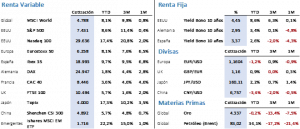
Equity markets posted broad gains on the prospect of an immediate end to the conflict. The S&P 500 rose 0.65%, reversing the week’s initial losses and closing at 7,431.46 points. The Nasdaq 100 gained 2.34% to finish at 29,635.95 points, with the technology sector particularly benefiting from lower bond yields. In Europe, gains exceeded 2%, allowing markets to recover part of the ground lost relative to global peers so far this year. The Euro Stoxx 50 closed at 6,187.63 points, up 2.07% from the previous week. Meanwhile, the Ibex finished at 18,764.40 points, representing a gain of 2.28%. Notably, several European indices, including the Euro Stoxx 50 and the Ibex 35, once again reached all-time highs, something that had not occurred for several weeks.
Bond markets also reacted positively following the announcement of an imminent truce. Government bond yields fell by approximately 5 basis points on average. The 10-year U.S. Treasury yield declined by 5 basis points to 4.49%. Meanwhile, the 10-year German Bund yield fell by 4 basis points to 3.00%, while the Spanish 10-year government bond yield dropped by 6 basis points to 3.42%. The reaction was more moderate than in equity markets, as inflationary pressures are expected to persist for several months even if the conflict ends immediately.
Commodities moved broadly in line with other markets. Falling bond yields supported precious metals toward the end of the week, lifting them away from their yearly lows, although not enough to close in positive territory. Gold ended the week at USD 4,238.80/oz, representing a weekly decline of 2.90%. Brent crude, meanwhile, fell to USD 87.33/bbl, a drop of 6.19%, bringing Europe’s benchmark oil price below USD 90/bbl at market close for the first time since the conflict in Iran began. Against this backdrop of increased calm, the U.S. dollar weakened against major currencies. It declined by 0.48% against the euro, and should a peace agreement materialize, the move could intensify in the coming weeks.
From a macroeconomic perspective, beyond the ECB meeting, several important data releases stood out. In China, import and export figures continued to demonstrate the strength of the Chinese economy observed in the previous month, giving the impression that the country remains relatively insulated from the broader global impact of the Middle East conflict. In the United States, the most important release was CPI inflation, which came in at 4.2%, in line with expectations, while core inflation rose by one-tenth to 2.9%. However, the monthly figure came in below estimates, a development that was positively received by financial markets overall.
Looking ahead to this week, the main macroeconomic events will be: (i) industrial production and the unemployment rate in China; (ii) the ZEW Investor Sentiment Index, industrial production, and the final May CPI reading in Europe; and (iii) retail sales, industrial production, and the Federal Reserve meeting in the United States, where interest rates are expected to remain unchanged.
The Quote:
We conclude with the following quote from Sir James Paul McCartney, singer-songwriter, composer, musician, peace activist, and philanthropist:
“In real life, the one who never gives up is truly brave.”
Summary of the Performance of Major Financial Assets (06/15/2026)