



Financial Markets 21/07/2026
A week marked by earnings reports and renewed geopolitical tensions in the Middle East. The truce reached at the end of June between Washington and Tehran has collapsed once again: the United States has resumed bombing Iranian territory after an Iranian missile attack this past weekend killed several US service members in Jordan. Iran has responded by striking infrastructure in Kuwait and disrupting traffic through the Strait of Hormuz. As a direct consequence, Brent crude oil surpassed $88 per barrel during the week, accumulating a rise of nearly 12%. This is a level high enough to challenge the narrative of disinflation, although still far from generating a scenario of significant tension.
After several weeks of gains that took numerous indices close to all-time highs, equities closed the week with corrections. Profit-taking in technology companies was accompanied by ongoing geopolitical and trade tensions worldwide, which temporarily increased investor risk aversion. On the one hand, there was the escalating conflict between the United States and Iran, as previously mentioned, and on the other hand, a sharp correction in the semiconductor sector following the unveiling by the Chinese startup Moonshot AI of a new artificial intelligence model called Kimi k3. This latter factor reignited doubts about the future profitability of the massive investments in AI infrastructure, as concerns grew about a potential technological rapprochement between China and the United States.
During the week, we will be closely watching the earnings reports from companies such as General Motors, Santander, Tesla, and Alphabet, among others. In general, the market expects continued positive results, which would help stock markets recover some of last week’s losses.
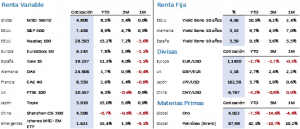
In equity markets, declines were widespread. The most notable sector, by far, was semiconductors and AI-related technology. The S&P 500 closed down 1.55% from last week, reaching 7,457.69 points, affected by investor caution ahead of earnings season. The Nasdaq 100 fell 4.13% to 28,592. In Europe, the Euro Stoxx 50 registered a very moderate decline of 0.63%, settling at 6,230 points, as did the Ibex 35, which fell 0.86% to 19,216.90 points, remaining very close to its highs.
In fixed-income markets, volatility continued to be the dominant feature. After several attempts at stabilization, yields rebounded, reflecting investor caution given inflation expectations that continue to show greater resistance than anticipated. The US 10-year bond closed the week around 4.55%, given the perception that the Federal Reserve could maintain a restrictive monetary policy for longer. In Europe, performance was more subdued. The German 10-year Bund settled near 3.12%, while the Spanish 10-year bond finished around 3.59%. The performance of both markets reflects a balance between moderate growth prospects and uncertainty about future decisions by the ECB.
In commodities, gold and oil performed mixed, with gold closing at $4,018.80/oz, representing a weekly decline of 2.3%, while Brent crude rose significantly to $88.10/bbl, pressured by increased hostilities in the Middle East. In the currency market, the dollar remained very stable against the euro, practically unchanged from last week, with the exchange rate closing at 1.1440. In an environment still marked by geopolitical and economic uncertainty, the dollar continues to benefit from its safe-haven status. However, any change in expectations regarding Federal Reserve interest rates could significantly alter this dynamic in the coming months.
Looking ahead to this week, the main macroeconomic indicators will be: i) PMIs and new home sales in the US; ii) In Europe, the ZEW investor confidence index and PMIs, and especially the ECB meeting on Thursday to decide on interest rates, where no changes are expected, so the focus will be on the tone used in the subsequent speech.
With this market outlook in mind, we’re taking a break until September, and we take this opportunity to wish you all a very happy summer.
The quote:
And we conclude with the following quote from Thomas Stearns Eliot, British-American poet, playwright, and literary critic, winner of the Nobel Prize in Literature in 1948: “We shall not cease our exploration, and at the end of our searching we shall arrive where we started and know it for the first time.”
Summary of the performance of major financial assets (July 20, 2026)
This report does not provide personalized financial advice. It has been prepared independently of the specific financial circumstances and objectives of the individuals who receive it.
This document has been prepared by Portocolom Agencia de Valores S.A. for the purpose of providing general information as of the date of issuance of the report and is subject to change without prior notice. Portocolom Agencia de Valores S.A. assumes no obligation to communicate such changes or to update the content of this document. Neither this document nor its content constitutes an offer, invitation, or solicitation to purchase or subscribe to securities or other instruments, or to make or cancel investments, nor may it serve as the basis for any contract, commitment, or decision of any kind.
The information included in this report has been obtained from public sources considered reliable, and although reasonable care has been taken to ensure that the information included in this document is neither uncertain nor ambiguous at the time of publication, we do not represent that it is accurate or complete and it should not be relied upon as such. Portocolom Agencia de Valores S.A. assumes no responsibility for any direct or indirect loss that may result from the use of the information provided in this report. Past performance of variables may not be a good indicator of their future outcomes.