


Financial Markets 22/09/2026
The week in which central banks were set to be the clear protagonists passed without surprises. Both the U.S. Federal Reserve (FED) and the Bank of Japan (BOJ) acted in line with market expectations, while the Bank of England (BOE) opted to leave rates unchanged. The FED and the BOJ raised their interest rates by 25 basis points.
The FED’s decision was supported by an environment of still-elevated inflation, with no clear signs of moderation in the short term, and by economic activity that continues to show notable resilience. This strength continues to be reflected particularly in the labor market, which led the central bank to maintain the forward guidance provided by Kevin Warsh during the Jackson Hole symposium.
Markets continued to register elevated levels of volatility, although somewhat lower than those observed in previous weeks. Uncertainty remains significant and stems from several fronts. First, the price of oil remains above USD 100 per barrel, making inflation normalization more difficult. It is worth remembering that crude oil is still trading approximately 50% above the levels recorded at the beginning of the attacks on Iran.
Second, geopolitical tensions continue to be a relevant factor. The conflicts in Ukraine and the Middle East remain active, while the planned meeting between Donald Trump and Xi Jinping represents a major diplomatic event for relations between the United States and China. In addition, ties between Russia and Europe continue to deteriorate.
Finally, the trade front should not be overlooked either. Tensions between the United States and Canada persist, and Canada’s rapprochement with Europe has been interpreted by the U.S. Administration as an action unfavorable to its interests, going so far as to describe it as hostile.
The macroeconomic data published during the week clearly reflected the divergence between the major economies. In Europe, the ZEW institute’s confidence index plunged to 25.8 points, well below the approximately 40 points expected by the market consensus. High energy costs and the deterioration of political relations with both Russia and the United States appear to have negatively affected investor sentiment. Likewise, industrial production continues to face difficulties in regaining momentum despite the recent improvement observed in manufacturing PMI indicators. The positive note came from inflation: the CPI fell by one tenth to 3.2%, while core inflation confirmed the 2.4% reported in the preliminary reading. In China, the unemployment rate rose to 5.3%, one tenth above expectations. However, industrial production surprised positively, growing by 5.2% versus the 4.8% forecast by the market.
The situation is significantly different in the United States. Beyond the rate hike implemented by the FED, the data continue to show a robust economy. Weekly unemployment claims once again reached multi-month lows, retail sales grew by 1.2% in August, clearly above the expected 0.8%, and the number of active oil drilling rigs increased to levels close to the highs of the past year. In addition, the Atlanta FED’s estimate of GDP growth for the third quarter of 2026 was raised to 5.1%.
This week’s macroeconomic agenda will be relatively light. In Europe, the publication of the European Central Bank’s economic bulletin and preliminary PMI data for September will be the highlights. In the United States, in addition to the PMIs, durable goods orders and the results of the University of Michigan survey on consumer confidence and inflation expectations will be released.
Although the environment described above is not particularly favorable for financial assets, the weekly balance can be considered reasonably positive, especially in the United States.
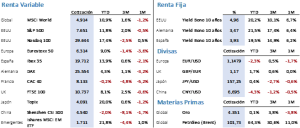
European equity markets recorded corrections of around 1.5%. The Euro Stoxx 50 ended the week at 6,236.20 points, while the Ibex 35 closed at 19,513.80 points. By contrast, U.S. equities showed greater resilience, supported both by the strength of the macroeconomic data and by solid corporate earnings, with Oracle standing out in particular. The S&P 500 ended the week with a slight decline of 0.08%, while the Nasdaq 100 advanced by nearly 1%. Both indices remain relatively close to their all-time highs, standing approximately 2.2% and 3.7% below those levels, respectively.
Fixed-income markets also experienced high volatility, although the final moves were relatively limited. The FED’s 25-basis-point rate hike, together with its message that another increase could still take place before year-end, reinforced the perception that the central bank’s priority remains the fight against inflation. However, the projections of voting members suggest that this potential additional move would be the last of the cycle and that no further rate hikes would occur during 2027. This view contrasts with current market expectations, which continue to anticipate further increases by both the FED and the ECB.
This divergence raises a relevant question: will markets ultimately adjust their expectations toward the scenario outlined by central banks, or will they continue to push interest-rate forecasts higher?
The yield on the U.S. 10-year Treasury increased by 2 basis points during the week and closed very close to 5%. In Europe, the yield on the German Bund reached 3.52%, while that of the Spanish bond stood at 4%, representing increases of 2 and 4 basis points, respectively.
Commodities ended the week with moderate changes, although fluctuations were significant. Brent recorded a difference of more than 8% between its weekly high and low. It ultimately closed down 0.71%, at USD 103.87 per barrel, following the announcement of the recovery of Saudi exports through its pipeline network.
Gold recovered part of the ground lost following the FED’s decision and closed at USD 4,424.90 per ounce, with a weekly gain of 0.34%. Meanwhile, the dollar was one of the main beneficiaries of the FED’s tougher message. The U.S. currency appreciated against most of its peers and gained approximately 1% against the euro, bringing the exchange rate to 1.1484 at the end of the week.
The quote:
And we leave you with the following quote from Leo XIV, 267th pope of the Catholic Church and ninth sovereign of Vatican City: «It is not the culture of confrontation, but that of encounter, that generates stability».
Summary of the performance
of major financial assets (9/21/2026)