


Financial Markets 14/10/2026
Markets face the start of earnings season in an environment of extreme uncertainty.
Political uncertainty and armed conflicts remain at very high levels. However, and seemingly contradictorily, US stock markets reached new all-time highs last week. This behavior could be anticipating particularly positive expectations for the new corporate earnings season, which begins this Tuesday, October 13. As is usually the case, the first relevant indicators will come from financial institutions. We will have to wait until the last weeks of the month for the major technology companies to present their quarterly results, although until then the market will have numerous corporate indicators capable of influencing investor sentiment. Furthermore, as companies publish their results, they will once again be able to actively intervene in the market through their share buyback programs. It is worth remembering that there are currently authorized buybacks totaling more than $1.3 trillion and that, historically, October and November tend to be particularly active months in this area. This factor could once again become a significant support for US equities in the coming weeks.
Geopolitical tension continues to influence energy markets.
The geopolitical landscape has barely changed compared to previous weeks, meaning that global tension remains very high. Evidence of this is that the price of Brent crude reached $106 per barrel on Monday, consolidating well above the levels seen at the beginning of summer. In the case of Iran, direct military activity remains relatively limited. Furthermore, President Trump announced last week that he will refrain from escalating his rhetoric against the Iranian regime until the US election process is over. However, this has not led to a reduction in regional tension, as clashes continue to be concentrated between the Houthis in Yemen and Saudi Arabia, backed by its allies. Nor are there any significant developments in the Middle East. While the United States continues to try to broker a lasting ceasefire agreement, Israel maintains its military operations in various areas of southern Lebanon, hindering any short-term stabilization scenario. Meanwhile, Ukraine remains under intense Russian military pressure. Attacks continue to affect key infrastructure and urban centers, causing civilian casualties and fueling a conflict that is far from a definitive solution. Adding to this are Trump’s recent statements publicly questioning Volodymyr Zelensky’s negotiating strategy and even calling for a political change in the Ukrainian leadership, a development that introduces a new element of uncertainty about the future course of the conflict.
Europe faces increasing political uncertainty
Although the situation in Europe has not reached the levels of tension seen in other parts of the world, the political environment is progressively deteriorating. The French budget crisis continues to gain prominence and exert pressure on European debt markets. Investors continue to express concern about the country’s ability to address its fiscal imbalances in a context of limited growth and high levels of public debt. In Spain, the announcement of early elections for November 29 adds a new element of uncertainty to the national political landscape. As is typical in these types of processes, political polarization is expected to increase, and the main political forces are likely to focus much of their activity on the election campaign in the coming weeks. The macroeconomy continues to play a secondary role. From a macroeconomic perspective, the data released during the week had a relatively small impact on market behavior. Among the most relevant data was the confirmation of the services PMIs for September. In the United States, the figures returned to clearly expansionary levels, while in Europe the data also maintained a positive tone, albeit somewhat more moderate. On the other hand, the minutes from the latest monetary policy meetings of the Federal Reserve and the European Central Bank offered little new information beyond what the market had already priced in. Both institutions continue to maintain a prudent stance, dependent on the evolution of inflation and economic growth. This week will also not be particularly busy with macroeconomic data. However, investors will be paying close attention to the September inflation figures for China, the United States, and Europe. Additionally, both the United States and Europe will release their respective industrial production data, indicators that should confirm the recent strength of economic activity.
The United States maintains its stock market lead.
Equity markets once again showed very different performances on either side of the Atlantic. While US indices continued to advance and register new all-time highs, European stock markets were again penalized by political uncertainty and doubts about the region’s economic outlook. Global equities fell somewhere in between, with the MSCI World Index rising 0.73% and closing very close to the psychological threshold of 5,000 points. In the United States, the S&P 500 advanced 1.15% to 7,811.72 points, while the Nasdaq 100 gained 0.25% to finish the week at 30,883.15 points. Both indices also reached new all-time intraday highs of 7,844.52 and 31,361.37 points, respectively. The situation was different in Europe. The Euro Stoxx 50 fell 1.04% to close at 6,173.37 points, while the Ibex 35 declined 0.27% to 19,085 points. This further widens the gap between the performance of the two markets, a trend that has characterized much of the current year.
Fixed income continues to seek equilibrium
Debt markets remained highly volatile, although within somewhat narrower ranges than those observed in previous weeks. The 10-year US Treasury yield ended the week at 5.24%, a drop of 4 basis points from the previous close. While the movement was moderate, it is significant because it partially breaks the strong upward trend observed in recent months. In Europe, sovereign yield curves also saw movement, albeit small. The German Bund yield increased by 4 basis points to 3.49%, while the Spanish Bond yield rose by just 1 basis point to close at 4.10%. If these benchmarks stabilize at current levels, it could be interpreted as the market having already priced in much of the expectation regarding future central bank actions. However, a significant division of opinion persists among analysts and financial institutions. In fact, a growing number of voices consider the current market expectations for interest rates to be excessive. If this interpretation prevails, a correction in yields during the final part of the year cannot be ruled out, especially once the US election process concludes and one of the main sources of current uncertainty diminishes.
Oil and the dollar continue to be key players
Commodities reflected a performance consistent with the rest of the financial assets. Precious metals managed to recover some of the ground lost in recent weeks, taking advantage of a slight reduction in tensions in fixed-income markets. Gold advanced 1.36% and ended the week at $4,216 per ounce, recovering some of the losses accumulated over the past month. Meanwhile, geopolitical tensions once again boosted crude oil. Brent crude rose 2.41% and closed at $104.72 per barrel, remaining well above the levels considered compatible with a moderation of global inflationary pressures. Finally, the US dollar continued to strengthen against major international currencies. Against the euro, it advanced 0.46% for the week, closing at 1.12 and reaching new yearly highs during the week. Outlook for the Coming Weeks Markets face the coming weeks with three key reference points: the corporate earnings season, developments in various geopolitical contexts, and expectations regarding inflation and interest rates. Although economic activity continues to show remarkable resilience, current valuations require companies to confirm the expectations implied by their share prices with their results. In this context, the performance of oil, fixed income, and companies’ ability to maintain earnings growth will likely be the factors that determine market direction in the final stretch of the year.
The quote:
And we leave you with the following quote from Navanethem Pillay (Navi Pillay), South African jurist, United Nations High Commissioner for Human Rights from 2008 to 2014, and recipient of the Nobel Peace Prize in 2016: «Don’t fall for false propaganda or just repeat slogans; make sure you check the evidence.»
Summary of the performance of major financial assets (14/10/2026) 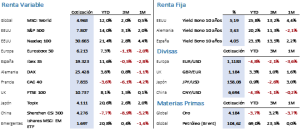
This report does not provide personalized financial advice. It has been prepared independently of the specific financial circumstances and objectives of the individuals who receive it.
This document has been prepared by Portocolom Agencia de Valores S.A. for the purpose of providing general information as of the date of issuance of the report and is subject to change without prior notice. Portocolom Agencia de Valores S.A. assumes no obligation to communicate such changes or to update the content of this document. Neither this document nor its content constitutes an offer, invitation, or solicitation to purchase or subscribe to securities or other instruments, or to make or cancel investments, nor may it serve as the basis for any contract, commitment, or decision of any kind.
The information included in this report has been obtained from public sources considered reliable, and although reasonable care has been taken to ensure that the information included in this document is neither uncertain nor ambiguous at the time of publication, we do not represent that it is accurate or complete and it should not be relied upon as such. Portocolom Agencia de Valores S.A. assumes no responsibility for any direct or indirect loss that may result from the use of the information provided in this report. Past performance of variables may not be a good indicator of their future outcomes.