



Financial Markets 20/10/2026
Markets Enter a Phase of Increased Risk Aversion Amid Rising Oil Prices
The week closed with a widespread decline in risk appetite. The geopolitical escalation in the Middle East once again dominated the agenda, raising the energy risk premium and particularly penalizing assets with the most demanding valuations. Against this backdrop, global stock markets retreated, while the Ibex 35 managed to buck the trend with a solid weekly gain.
This movement reflects a significant shift from the previous week: the market has moved from focusing on earnings season to more intensely assessing the risk that persistently above $100 oil will fuel inflation again and limit the room for maneuver by central banks. The combination of reduced geopolitical visibility, higher energy costs, and still-elevated sovereign yields has favored a more defensive outlook. The correction was particularly sharp in the Nasdaq 100, suggesting more pronounced profit-taking in technology and long-duration segments. In the short term, the evolution of corporate profits will continue to be important, but crude oil, inflation data, and developments in Yemen and Iran have become the main market drivers.
The escalation in Yemen reinforces the oil risk premium.
The weekend’s developments confirm that geopolitical tensions continue to escalate. The Houthis attacked the Al-Maashiq presidential compound in Aden, and missile strikes were subsequently reported at the city’s international airport. This incident increases the risk of a broader regional response and keeps energy and trade routes near the Red Sea under pressure.
The attack on Aden is particularly significant because it strikes the headquarters of the internationally recognized Yemeni government. The Houthis maintain that their target was a facility linked to Saudi military operations, while local authorities reported casualties among security personnel and civilian employees. Beyond the immediate military impact, the spread of hostilities to political and airport infrastructure increases the risk of logistical disruptions and further attacks against Saudi interests. Meanwhile, the Strait of Hormuz remains the primary source of risk for the energy market. The possibility of new naval restrictions or a tightening of measures against Iran keeps transportation and insurance costs high. The International Energy Agency has described the recent supply recovery as fragile. According to its October report, global production increased in September to 102.3 million barrels per day, but the continued attacks in the Persian Gulf continue to hinder normalization. The same source anticipates a sharp contraction in demand during 2026 due to shortages, rising fuel prices, and the economic downturn, with particular pressure on diesel.
Europe combines stock market weakness and inflationary pressure.
Europe is once again in a vulnerable position in the face of the energy rebound. The region is more dependent on energy imports and is therefore more exposed to a prolonged increase in the price of crude oil, shipping, and refined products.
European industrial production fell by 0.5%, below the expected 0% and the previous decline of 0.3%. This figure confirms that industrial activity continues to show little dynamism. At the same time, the CPI for September stood at 3.8% and core inflation at 2.5%, levels that make a rapid easing of monetary policy difficult. In Spain, the Ibex 35 stood out positively with a weekly rise of 1.54%, to 19,326.30 points. This relative performance can be explained by its more defensive composition and the weight of banks, energy companies, and infrastructure, sectors that tend to withstand pressure better than technology when inflation expectations rise and interest rates remain high. However, the divergence between Spain and the rest of Europe does not eliminate the common risks. Sustained triple-digit oil prices can put pressure on corporate margins, delay disinflation, and weaken consumption. Therefore, the evolution of energy prices will be crucial for interpreting upcoming economic activity and confidence data.
Macroeconomics regains prominence due to inflationary risk
Data released last week offered mixed signals. In China, the September CPI came in at 0.9%, compared to the expected 1.0% and the previous 0.8%. Exports grew by 36.3%, exceeding the forecast of 25.5% and the previous 25%, while imports advanced by 31%, also above the benchmarks of 24.5% and 28.2%. Overall, the figures point to a dynamic external sector, although domestic inflation remains moderate, demonstrating weak internal demand.
In the United States, the September CPI reached 3.7%, one-tenth of a percentage point above expectations, and core inflation stood at 2.6%, also slightly above the consensus of 2.5%. Retail sales rose 0.8%, compared to the expected 0.3%, and industrial production grew 0.7%, exceeding the anticipated 0.4%. The economy retains resilience, but the combination of strong demand and high energy costs reduces the likelihood of a rapid monetary policy shift. This week, attention will focus on China’s third-quarter GDP, its industrial production, and the September unemployment rate. In Europe, the key releases will be the Eurozone ZEW investor confidence index and the preliminary October PMIs. In the United States, the Leading Indicator, preliminary PMIs, and the University of Michigan’s inflation and consumer confidence expectations will be published.
The correction is concentrated in the United States and in the technology sector.
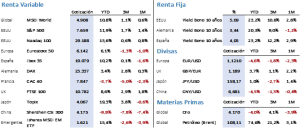
Equities closed a decidedly negative week across the major international indices. The S&P 500 fell 1.95% to 7,659.44 points, while the Nasdaq 100 dropped 5.34% to close at 29,187.55 points. The magnitude of the tech adjustment reflects the sensitivity of growth companies to an environment where inflation may remain high and bond yields continue to be restrictive. When the market fears that interest rates will remain high for longer, the present value of future earnings decreases, and companies with high multiples suffer more. In Europe, the Euro Stoxx 50 declined 2.42% to 6,024.23 points. The Ibex 35, on the other hand, rose 1.54% to close at 19,326.30 points. This dispersion confirms that sectoral composition is having an increasing weight: indices with greater exposure to technology and consumer discretionary have lagged behind those with a stronger presence in financial, energy, and defensive sectors.
Fixed income offers partial, but not definitive, relief.
Sovereign yields fell during the week, a move consistent with increased demand for safe-haven assets and fears that the energy shock will ultimately weaken growth. The 10-year US Treasury yield fell from 5.24% to 5.10%, a drop of 14 basis points. Despite the decline, the absolute level remains high and maintains restrictive financial conditions for households and businesses. In Europe, the 10-year German Bund yield fell from 3.49% to 3.41%, while the Spanish Bond yield dropped from 4.10% to 4.01%. These movements represent declines of approximately 8 and 9 basis points, respectively, and demonstrate a relatively orderly reaction despite the increased uncertainty.
The fall in yields should not yet be interpreted as an unequivocal sign of monetary easing. The market is facing two opposing forces: on the one hand, a potential deterioration in growth that would favor a loosening of monetary policy; on the other, higher oil prices that could raise inflation and force central banks to maintain a cautious stance. Until this tension is resolved, volatility is likely to continue, and yield curves are expected to react strongly to both inflation data and any geopolitical developments.
Oil rises sharply while precious metals correct
Brent crude was the top performer among the assets analyzed this week. The price of a barrel advanced 4.91%, from $104.72 to $109.86, consolidating in triple-digit levels. This movement reflects that occasional improvements in physical supply have not been enough to offset the risk premium associated with the Strait of Hormuz, Yemen, and Saudi infrastructure. Volatility will remain high until the market has greater visibility on shipping routes and effective production capacity.
Precious metals moved in the opposite direction. Gold fell 0.83% to $4,181.10 per ounce, and silver dropped 6.13% to $57.31. Silver’s correction was particularly sharp, consistent with its greater volatility and its dual sensitivity as a safe-haven asset and an industrial metal. Even so, geopolitical tensions and declining sovereign yields could limit further losses for gold. In currencies, the euro appreciated slightly against the dollar. The EUR/USD pair rose from 1.1202 to 1.1240, representing a weekly gain of 0.34%. The movement was moderate and does not alter the main market message: the direction of currencies will continue to be heavily influenced by the comparison of inflation, growth, and interest rate expectations on both sides of the Atlantic.
Outlook for the Coming Weeks
Markets face the coming sessions with four key indicators: military developments in Yemen and the Persian Gulf, Brent crude’s ability to remain above $100, the release of preliminary PMIs, and US consumer inflation expectations. Geopolitical stabilization would allow for a reduction in the energy premium; however, a renewed escalation would reinforce the risk of stagflation and maintain pressure on longer-term equities.
In this context, a balanced perspective is advisable. The US economy continues to show strength, China is offering positive signs in foreign trade, and fixed income has partially acted as a safe haven. However, the sharp correction in the Nasdaq, the weakness in the Euro Stoxx 50, and the Brent rebound indicate that the market has clearly heightened its perception of risk. The key will be to see whether this episode remains limited to a tactical correction or ultimately translates into higher inflation, margins, and consumption.
With earnings season already underway, we’ll be closely watching the results from Meta, Lam Research, Texas Instruments, SpaceX, Tesla, and Netflix—all technology companies that could shed light on the sector’s outlook for the coming months.
Quote:
And we leave you with this quote from António Guterres, Secretary-General of the United Nations: «The world needs peace, peace is the way, but it requires political will.»
Summary of the performance of major financial assets (October 19, 2026)
This report does not provide personalized financial advice. It has been prepared independently of the specific financial circumstances and objectives of the individuals who receive it.
This document has been prepared by Portocolom Agencia de Valores S.A. for the purpose of providing general information as of the date of issuance of the report and is subject to change without prior notice. Portocolom Agencia de Valores S.A. assumes no obligation to communicate such changes or to update the content of this document. Neither this document nor its content constitutes an offer, invitation, or solicitation to purchase or subscribe to securities or other instruments, or to make or cancel investments, nor may it serve as the basis for any contract, commitment, or decision of any kind.
The information included in this report has been obtained from public sources considered reliable, and although reasonable care has been taken to ensure that the information included in this document is neither uncertain nor ambiguous at the time of publication, we do not represent that it is accurate or complete and it should not be relied upon as such. Portocolom Agencia de Valores S.A. assumes no responsibility for any direct or indirect loss that may result from the use of the information provided in this report. Past performance of variables may not be a good indicator of their future outcomes.