



Financial Markets 27/10/2026
Oil is once again setting the tone for markets closely watching central banks. Last week left equities with a negative balance and confirmed that energy risk has taken center stage. Brent crude rose sharply to $116.72 per barrel, while stock markets retreated on both sides of the Atlantic. The combination of geopolitical tension, rising energy prices, and upcoming central bank meetings led investors to reduce their risk exposure, even in an environment where economic activity data continues to show considerable resilience.
The coming week will be marked by two questions: i) whether the tension in the Strait of Hormuz will continue to drive energy prices, despite the fact that crude oil volumes leaving the Middle East are at pre-war levels, and ii) whether central banks will maintain their message in the face of the moderation observed in some sovereign yields.
The war between the United States and Iran keeps energy at the heart of the market. The geopolitical focus remains particularly on the Middle East. US forces blocked an oil tanker accused of violating the naval blockade of Iranian ports. The incident represents an increase in direct military intervention and raises the possibility of further unrest. Amid this tension, an agreement was announced between the United States and Russia to supply 300,000 tons of diesel to international markets. The initiative aims to alleviate the shortage of refined products, but it has also opened a new political front with Ukraine.
Against this backdrop, Brent crude closed the week at $116.72, up 6.24%. This is also the highest weekly close since May 2012. The International Energy Agency noted in its October report that the supply recovery remains fragile, that global inventories fell in September, and that the diesel market remains under significant pressure.
Global growth holds firm, but the risk of fragmentation increases.
The International Monetary Fund maintains its global growth forecast of 3.1% for 2026, while anticipating global inflation of 4.7%. The underlying message is less reassuring than the figures: the depletion of some emergency energy reserves and the limited budgetary space of numerous governments could test the resilience of the global economy.
Investment linked to artificial intelligence continues to act as a counterweight to the energy shock. However, global growth appears increasingly concentrated in economies connected to the technology value chain or those benefiting from their energy exports.
Finally, we highlight the proximity of the US midterm elections on November 3, which are an additional source of uncertainty, especially given the potential reactions of Trump.
Europe loses momentum as political risks increase.
European data from last week showed a loss of dynamism. The ZEW eurozone investor confidence index fell to 18.5 points from 25.8 in the previous reading. The preliminary October PMIs remained in expansionary territory, but also moderated: the manufacturing PMI stood at 52.4 and the services PMI at 51.7.
The region also faces a more turbulent political environment. France continues to be mired in an institutional and social crisis, exacerbated by the protests following the attack in Trappes and by the proximity of the presidential elections.
The combination of lower confidence, political disputes, and energy dependence leaves Europe particularly vulnerable to expensive oil. The release of third-quarter GDP figures, for which growth of 1.1% is expected, will reveal the extent to which the economy has withstood the deteriorating environment. We will also learn the unemployment rate for September, estimated at 6.4%, unchanged from August.
China maintains moderate growth, while the United States remains stronger.
China reported year-on-year GDP growth of 4.5%, slightly higher than the previous 4.3%. Industrial production advanced 5.5%, also exceeding expectations, while the unemployment rate fell to 5.2%. While there is no clear improvement, the economy appears capable of sustaining activity within a complex international context.
In the United States, the preliminary October PMIs remained in a clearly expansionary position. The manufacturing index rose to 56 points, while the services index corrected to 57.9 from the previous 58.8. The University of Michigan consumer confidence index exceeded expectations, reaching 48 points, although it remains at historically low levels.
Throughout this week, attention will focus on the Fed’s decision and, especially, its subsequent comments. Other key indicators will be: i) The Conference Board’s consumer confidence index, ii) the first reading of US Q3 GDP, with an estimate of 3.2%, and iii) the September Personal Consumption Expenditures (PCE) index.
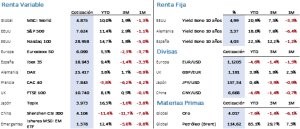
Stock markets correct across the board, with Europe lagging behind again. Equities closed the week with declines in all the analyzed indices. The S&P 500 fell 0.47% to 7,623.68 points, and the Nasdaq 100 lost 0.79% to 28,957.53. The US correction was moderate on a weekly basis, but it confirms that the technology sector remains sensitive to any increased uncertainty surrounding inflation, interest rates, and the sustainability of high investments in artificial intelligence.
The declines were more pronounced in Europe. The Euro Stoxx 50 fell 2.19% to 6,068.22 points, and the Ibex 35 lost 1.74% to 18,989.80. The weaker performance in Europe reflects its greater sensitivity to energy prices and a less favorable combination of growth, confidence, and political stability.
Fixed income stabilizes ahead of the Federal Reserve and ECB. Government debt showed a more defensive performance. The yield on the 10-year US Treasury fell from 5.10% to 4.99%, a drop of 11 basis points. This movement can be interpreted as a partial flight to safety and as a sign that the market is beginning to factor in the negative impact that high oil prices could have on economic activity.
In Europe, the yield on the 10-year German Bund fell from 3.41% to 3.34%. The Spanish bond yield, on the other hand, rose from 4.01% to 4.05%, slightly widening the spread against Germany. This development suggests that risk perception has not been evenly distributed and that investors continue to differentiate between issuers.
The Federal Reserve and the European Central Bank will hold their monetary policy meetings this week. No changes to benchmark interest rates are expected, so attention will be focused on the tone of their statements.
Brent crude surges while gold and silver extend their correction. Oil was by far the best-performing asset. Brent crude advanced 6.24% to $116.72 per barrel. In a market with tight inventories and high transportation costs, any incident in the Middle East can produce sharp movements.
Precious metals followed the opposite trend. Gold fell 4.14% to $4,007.90 per ounce, while silver declined 5.85% to $53.95. The magnitude of the adjustment shows that increased geopolitical risk does not always automatically translate into safe-haven purchases: profit-taking, the need for liquidity, and expectations about real interest rates also play a role. In the currency market, the euro depreciated 0.33% against the dollar, and the EUR/USD exchange rate closed at 1.1203.
The quote:
And we conclude with the following quote from Miguel Servet, theologian and scientist: “Each person is as God made them, but becomes what they make of themselves.”
Summary of the performance of main financial assets (October 26, 2026)
This report does not provide personalized financial advice. It has been prepared independently of the specific financial circumstances and objectives of the individuals who receive it.
This document has been prepared by Portocolom Agencia de Valores S.A. for the purpose of providing general information as of the date of issuance of the report and is subject to change without prior notice. Portocolom Agencia de Valores S.A. assumes no obligation to communicate such changes or to update the content of this document. Neither this document nor its content constitutes an offer, invitation, or solicitation to purchase or subscribe to securities or other instruments, or to make or cancel investments, nor may it serve as the basis for any contract, commitment, or decision of any kind.
The information included in this report has been obtained from public sources considered reliable, and although reasonable care has been taken to ensure that the information included in this document is neither uncertain nor ambiguous at the time of publication, we do not represent that it is accurate or complete and it should not be relied upon as such. Portocolom Agencia de Valores S.A. assumes no responsibility for any direct or indirect loss that may result from the use of the information provided in this report. Past performance of variables may not be a good indicator of their future outcomes.