


Financial Markets 03/11/2026
Central banks pause, but oil and politics keep markets cautious The last week of October delivered a mixed picture. US equities and the Ibex 35 declined, while the Euro Stoxx 50 managed to advance. At the same time, government bond yields fell and oil pulled back from very elevated levels. The overall message is clear: investors remain confident that economic activity can hold up, but they are not willing to ignore the risk that energy could fuel inflation again and force interest rates to remain higher for longer.
The Federal Reserve and the ECB keep interest rates unchanged The Federal Reserve kept its benchmark rate in the 3.75%-4.00% range, while the European Central Bank left its deposit facility rate at 2.50%. Both institutions opted to buy time in a complex environment: growth remains relatively resilient, but inflation continues to run above target and higher energy prices pose an additional risk. The decision does not mean that the tightening cycle is over. Rather, it confirms that the next moves will depend on inflation, employment and activity data.
The fixed-income market reaction was relatively positive in the United States. The 10-year Treasury yield ended close to 4.93%, down from 4.99% the previous week. In Europe, the German Bund yield fell to 3.32% and the Spanish government bond yield to 3.95%. The decline in yields suggests a search for protection and a somewhat more cautious view of growth, although absolute levels remain high and continue to increase financing costs for households, companies and governments.
The United States maintains solid growth, but inflation remains present US macroeconomic data offered an uncomfortable combination for monetary policy. Third-quarter GDP grew by 3.4% on an annualised basis, above the 3.2% expected and the 2.2% recorded in the second quarter. The Conference Board Consumer Confidence Index also improved to 91.7 points from 84.2. However, the Personal Consumption Expenditures price index for September rose to 3.6%, in line with expectations but still well above the Federal Reserve’s price stability target.
This combination of growth and inflation explains why the market cannot consider the interest rate debate closed. A strong economy reduces the immediate risk of recession, but it also allows the Federal Reserve to maintain a restrictive policy stance. In the coming days, the JOLTS job openings survey, ADP private employment, nonfarm payrolls and the October unemployment rate will be particularly important. A resilient labour market would reinforce the higher-for-longer interest rate narrative; a clear slowdown would ease some of the pressure on bonds and growth companies.
The outcome of the election taking place today, 3 November, in the United States will shape the future direction of government policies. The situation in Iran, economic policies and international relations will be affected to a greater or lesser extent depending on the decision made by voters.
Europe grows more than expected, although it remains exposed to the energy shock The eurozone surprised positively with year-on-year growth of 1.3% in the third quarter, compared with the 1.1% estimate. However, the unemployment rate for September rose by one tenth to 6.5%, while the August figure was revised to the same level. The region continues to show moderate and uneven expansion, with greater sensitivity than the United States to energy costs, fiscal pressures and political uncertainty.
This week will see the release of October manufacturing PMIs, the preliminary estimate of eurozone inflation and September retail sales. The key issue will be whether industrial activity is beginning to stabilise and whether expensive oil is starting to feed through more visibly into prices. A rebound in inflation would limit the ECB’s room for manoeuvre, while weak PMIs would increase concerns about growth. France will remain an important focus given the political and fiscal tensions already affecting its bond market.
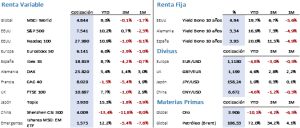
Equities end the week with mixed performance The S&P 500 fell 0.72% to close at 7,580.90 points, while the Nasdaq 100 declined 1.98% to 28,384.85. Technology once again showed greater sensitivity to financing costs and concerns about the future profitability of major investments in artificial intelligence. Corporate earnings confirmed that AI-related growth continues, but also that the market requires visible monetisation and reasonable control over spending on data centres, servers and semiconductors.
In Europe, the Euro Stoxx 50 advanced 1.04% to 6,131.31 points, while the Ibex 35 fell 1.77% to 18,652.90. The MSCI World declined 0.25%, reflecting a slightly negative global tone. Dispersion across indices and sectors remains high: energy, banks and defensive stocks may benefit from high interest rates or expensive oil, while technology, consumer discretionary companies and highly leveraged businesses tend to suffer more when required rates of return increase.
Oil pulls back, but remains the main risk for markets Brent crude fell 2.82% over the week to $113.43 per barrel. The correction provides some relief, but does not change the underlying picture: crude remains at levels capable of putting pressure on inflation, corporate margins and consumption. Developments in the Middle East conflict and the security of routes around the Strait of Hormuz will continue to determine the energy risk premium. Until there is a clear de-escalation, any incident could trigger sharp market movements.
Precious metals also declined. Gold fell 2.72% to $3,898.90 per ounce and silver lost 8.66% to $49.28. The decline demonstrates that an uncertain geopolitical environment does not guarantee continuous gains for safe-haven assets. Profit-taking, liquidity and expectations surrounding real interest rates can weigh just as heavily as political risk. The euro, meanwhile, depreciated by 0.38% against the dollar, closing at 1.1160.
US politics and employment take centre stage this week The US legislative elections on 3 November will be the main political event. Markets will assess the composition of Congress and its potential implications for taxation, regulation, energy, healthcare, defence and infrastructure. More than the result itself, what will matter is the new majority’s ability to pass measures and the Administration’s response. Caution could increase in the days beforehand, particularly if polls point to a close result or if the electoral process is called into question.
At the corporate level, attention will focus on Apple, Palantir, AMD, Qualcomm, McDonald’s, Uber, MercadoLibre, Airbnb, ConocoPhillips and Berkshire Hathaway. Their results will help assess four key issues: technology and artificial intelligence demand, the strength of consumer spending, developments in travel and the impact of oil prices on the energy sector. The earnings season will be particularly useful in determining whether profit growth justifies valuations that remain elevated in some market segments.
Outlook for the coming days The central scenario remains one of positive growth, elevated inflation and restrictive interest rates. The pause by the Federal Reserve and the ECB reduces immediate pressure, but does not eliminate the risk of further rate hikes if energy prices and inflation accelerate again. Market direction will therefore depend on three factors: the US election result, developments in oil prices and the strength of employment data. A simultaneous moderation in inflation and economic activity would favour bonds and technology stocks. Conversely, higher oil prices combined with strong employment would maintain pressure on yields and increase equity market volatility.
Quote:
And we close with the following quote from John James Audubon, a French naturalist and painter who became a US citizen in 1812 and is considered America’s first ornithologist: “A true conservationist is a person who knows that the world is not a gift from his parents, but a loan from his children«.
Summary of the performance of major financial assets (3/11/2026)