


Financial Markets 16/11/2026
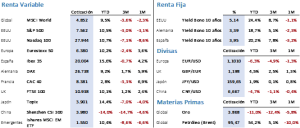
The past week was marked by a broad-based recovery in risk assets. Major stock market indices posted strong gains despite a challenging macroeconomic environment and heightened geopolitical uncertainty. The S&P 500 rose by 2.14%, the Nasdaq 100 by 3.53%, the Euro Stoxx 50 by 3.51% and the Ibex 35 by 3.36%, consolidating above the 20,000-point mark. Improving investor sentiment coincided with a less favourable message from inflation data and bond markets. Price data released in the United States and Spain came in above expectations, reducing the likelihood of interest rate cuts in the short term.
Equities: European outperformance and a technology sector recovery
Stock markets reacted positively to generally solid corporate earnings and the perception that the global economy continues to grow, albeit at a more moderate pace. The United States once again relied on its major technology stocks, while Europe stood out thanks to the performance of banks and energy companies. The Ibex 35 was one of the strongest-performing indices, supported by financial institutions, Repsol, Redeia and Endesa. The week was also marked by Nvidia’s corporate crisis following Jensen Huang’s resignation, a development that triggered episodes of volatility but did not prevent the indices from recovering.
Fixed income: bonds once again reflect inflationary pressures
The other side of the stock market rally was the performance of government bonds. The yield on the US 10-year Treasury rose from 4.86% to 5.15%, while the German Bund increased from 3.25% to 3.38% and the Spanish 10-year bond from 3.84% to 3.94%. The message is clear: investors continue to demand higher yields amid the risk that inflation may take longer to converge towards central bank targets. Markets are pricing in a more cautious monetary policy stance from both the Federal Reserve and the European Central Bank.
Commodities and currencies: gold correction and oil stability
Alternative assets showed a mixed performance. Gold fell by 4.6% and silver by 5.4%, affected by the rise in real interest rates. Brent crude also edged lower to $95.8 per barrel, although it remains at historically elevated levels due to geopolitical tensions in the Middle East and the risks surrounding the Strait of Hormuz. In the foreign exchange market, the euro lost ground against the dollar, with the EUR/USD exchange rate closing at 1.1023, reflecting the relative strength of the US economy and expectations of higher interest rates.
Inflation and growth: the main focus of attention
Inflation once again took centre stage in the economic debate. In Spain, the CPI reached 4.9%, its highest level since early 2023, driven by rising energy costs. In the United States, monthly CPI for October increased by 0.4%, one tenth of a percentage point above expectations. Meanwhile, producer prices continued to accelerate. In Europe, economic growth remains positive but moderate, while China continues to show a marked divergence between solid industrial production and still-weak domestic demand.
Companies: earnings and significant corporate developments
Corporate attention focused on Jensen Huang and the governance crisis facing Nvidia, following the resignation of its founder and CEO amid regulatory investigations and allegations relating to the suspected irregular export of advanced technology to China. The news triggered a significant increase in volatility across the technology sector and reignited debate over the market’s dependence on a small group of companies linked to artificial intelligence. Investors will now turn their attention to Nvidia’s quarterly earnings, due to be released later this week. This will be a key event in assessing demand for advanced semiconductors, the pace of investment in artificial intelligence infrastructure and the company’s ability to sustain the high growth expectations that have supported the sector’s strong revaluation in recent years.
Geopolitics: the Middle East continues to weigh on markets
Geopolitical uncertainty remains one of the most significant factors for investors. The potential course of the war with Iran and the situation surrounding the Strait of Hormuz continue to have a direct impact on energy markets and global inflation.
During the week, an unprecedented meeting between Donald Trump, Xi Jinping and Vladimir Putin was also confirmed, to take place on the sidelines of the APEC summit. Markets are watching this meeting closely given its potential implications for international trade, commodities and geopolitical stability.
What to watch this week
The economic calendar over the coming days will focus on three main areas. In the United States, retail sales, industrial production and the minutes of the Federal Reserve’s latest meeting will be released. In Europe, key releases will include industrial production, the ZEW Economic Sentiment Index and the final October inflation figures. In China, attention will focus on industrial production and the unemployment rate.
From a political perspective, markets will closely monitor the Spanish election campaign ahead of the 29 November elections, as well as any diplomatic developments relating to Iran and the forthcoming meeting between the United States, China and Russia. All these factors will determine whether stock markets can extend their recent gains or whether inflationary pressures and bond yields will once again take centre stage.
The quote:
We conclude with the following quote from Leo Tolstoy, the Russian writer regarded as one of the most important authors in world literature: “In the middle of winter, I find within myself an invincible summer”.
Summary of the performance of major financial assets (16/11/2026)