



Financial Markets 03/03/2026
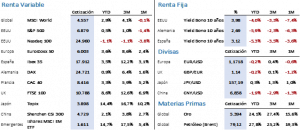
Beacon of the markets The situation in Iran has overshadowed both macroeconomics and the events of last week in the financial markets. The bombing began after the markets had already closed, so we had to wait until the start of trading on Monday, March 2nd, to understand the magnitude of the impact. Government bonds opened with slight declines in their yields, suggesting that at least part of the market had anticipated the attacks last week. Meanwhile, European stock markets opened with losses exceeding 2%, while precious metals, and especially oil prices, rose. The Strait of Hormuz, through which approximately 20% of the world’s oil passes, has been affected by the conflict, and although most of the crude produced in the region (just over three-quarters) is destined for Asia, fears of an escalation and prolongation of the war have driven the price of a barrel up to $80. If crude oil prices don’t correct soon, the anticipated drop in inflation over the next few months might not materialize. Regarding the analysis of events leading up to the close of trading last Friday, we want to highlight several noteworthy developments, all directly related to the US economy, both due to the available data and some forecasts that are gaining traction. Factory orders, for example, fell by 0.7%, significantly more than expected, a figure that contrasts sharply with the 2.7% increase in November. Furthermore, following the positive inflation data released two weeks ago, the Purchasing Power Purchase Index (PPI) rose sharply in January, a figure that currently casts doubt on the possibility of controlling inflation. But the most significant development occurred in the debt market, with the 10-year US Treasury bond closing with yields falling to 3.96%. The explanation for this movement lies in forecasts suggesting that the advancement of AI will lead to job losses in many sectors, consequently impacting consumption and, therefore, economic growth. The first reaction is to buy safe-haven assets in the face of a negative economic outlook. The second would be a faster-than-expected and more significant interest rate cut, which would validate the current movement. In any case, let’s not forget the potential impact on the market of the renewed uncertainty surrounding the trade war and the agreements reached to date. The question we can ask ourselves is, what has changed in the last two weeks to cause such an abrupt movement in just two sessions? Have there been significant bond purchases in anticipation of the war in Iran? The truth is that the fear that AI will significantly affect employment levels is a well-known and accepted argument in the market, but after a dismal PPI data release, the movement in fixed income leaves some doubts. Let’s stick with the following rule: if the yield on the 10-year Treasury note is above 3.75% and below 4%, there are doubts about future economic growth; if it falls below 3.75%, the market would be pricing in an economic contraction. Data indicates that the US GDP will grow by close to 3% in the first quarter of 2026, so a rebound in short-term yields wouldn’t be surprising. In equity markets, we can consider the final week of February as a transitional one, in which the main indices experienced minimal movement. In the United States, the S&P 500 fell 0.44% to close at 6,878.88 points, and the Nasdaq 100 followed suit, declining 0.21% to 24,963.04 points. Conversely, European stock markets closed higher, with the Euro Stoxx 50 rising 0.12% to 6,138.41 points, and the Ibex 35 gaining 0.96% to finish the month at 18,360.80 points. It’s worth noting that the two European indices we monitor reached new all-time highs: the new benchmarks are 6,199.78 and 18,573.80 points, respectively. The weekly performance of government bonds was fairly consistent, with a slightly larger correction in the United States due to its higher yield. The 10-year Treasury fell 13 basis points (particularly on Thursday and Friday) and closed the week with a yield of 3.96%. The Bund declined 9 basis points to finish at 2.55%, and the Bond also fell 9 basis points to close at 3.06%. The market has abruptly reversed its forecasts and appears to be overlooking the large budget deficits and the massive debt issuance that will hit the market in the coming months, not to mention the possibility that the United States may have to repay the $170 billion collected from tariffs declared illegal by its Supreme Court. The most notable weekly movement was seen in silver, which gained 12.86% for the week, closing at $93.64/oz. Precious metals once again acted as a safe haven and are approaching their all-time highs. The ultimatum issued to Iran seems to have supported the buying argument, as gold also appreciated by 3.67%, rising to $5,267.20/oz. Brent crude, for the same reason, closed higher again, in this case by 2.20% to $72.87/bbl. As we have mentioned, the closure of the Strait of Hormuz jeopardizes 20% of the world’s crude oil supply, particularly affecting countries like India, China, and Japan, which are heavily dependent on supplies from the Middle East. On the macroeconomic front, we will see the following key data points this week: i) Europe: the PMI data, the provisional CPI figure for February, retail sales for the last month, and the minutes from the last ECB meeting. ii) United States: PMIs, the ADP employment survey, the Fed’s Beige Book, retail sales data, and on Friday we’ll see the official employment and unemployment rate figures. Earnings season is drawing to a close. Nvidia lived up to expectations and exceeded market forecasts for both its last quarter results and its outlook for the coming months, but the high valuations triggered profit-taking. With Nvidia’s stock falling more than 6% this week, the Nasdaq 100 barely corrected, and valuations appear to be adjusting across all market segments. To date, 96% of S&P 500 companies have reported, with 73% exceeding estimates. Earnings per share (EPS) are projected to grow by 14.2% in the fourth quarter of 2025, compared to the initial forecast of 8.8%. The quote: And we conclude with the following quote from Carl Gustav Jung, Swiss psychiatrist, psychologist, and essayist, considered a key figure in the beginnings of psychoanalysis: “Until you make the unconscious conscious, it will direct your life and you will call it fate.” Summary of the performance of major financial assets (March 2, 2026)
This report does not provide personalized financial advice. It has been prepared independently of the specific financial circumstances and objectives of the individuals who receive it.
This document has been prepared by Portocolom Agencia de Valores S.A. for the purpose of providing general information as of the date of issuance of the report and is subject to change without prior notice. Portocolom Agencia de Valores S.A. assumes no obligation to communicate such changes or to update the content of this document. Neither this document nor its content constitutes an offer, invitation, or solicitation to purchase or subscribe to securities or other instruments, or to make or cancel investments, nor may it serve as the basis for any contract, commitment, or decision of any kind.
The information included in this report has been obtained from public sources considered reliable, and although reasonable care has been taken to ensure that the information included in this document is neither uncertain nor ambiguous at the time of publication, we do not represent that it is accurate or complete and it should not be relied upon as such. Portocolom Agencia de Valores S.A. assumes no responsibility for any direct or indirect loss that may result from the use of the information provided in this report. Past performance of variables may not be a good indicator of their future outcomes.