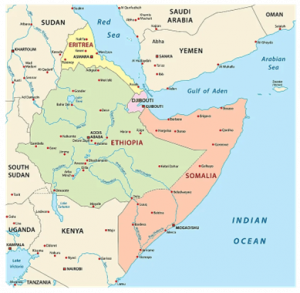



The Horn of Africa
March 24. 2026
By Jaime Martín Borregón
There are regions that, despite being crucial to the world order, rarely make headlines. The Horn of Africa is one of them. Located in the northeastern corner of the continent, facing the Bab-el-Mandeb Strait and the entrance to the Red Sea, this territory shapes one of the most important trade flows on the planet: approximately 12% of global trade passes through the Suez Canal, connecting Asia, Europe, and Africa. Whoever controls this region, or whoever destabilizes it, holds a lever of global power.
Its importance is not limited to maritime routes. The region is home to natural resources of enormous potential, such as the Grand Ethiopian Renaissance Dam, built on the Blue Nile. With a capacity of some 6,000 MW, it is the largest hydroelectric plant in Africa and could transform Ethiopia into a regional energy powerhouse. But this same infrastructure has generated deep tensions with Egypt and Sudan over control of the Nile’s water, demonstrating how resources here become a source of geopolitical conflict as much as a driver of development. Added to this is an extraordinary ethnic and religious diversity: Christian communities predominate in the mountainous interior, while the majority of the population is Muslim along the coasts and in the lowlands. And, as a fact that underscores the historical importance of this land, it was here that the 3.2-million-year-old fossil of Lucy was discovered, one of the most important finds for understanding the origin of our species.
Against this strategic backdrop, the region has become the stage for intense competition among powers. Saudi Arabia, the United Arab Emirates, Egypt, Turkey, Israel, China, the United States, and Russia compete to influence the area’s ports, governments, and trade routes, each seeking to secure its commercial, military, or regional influence interests. The most revealing case is Djibouti: a small country with few resources of its own that nevertheless hosts US, Chinese, and French military bases simultaneously, precisely because the Bab-el-Mandeb Strait, one of the most critical bottlenecks in global trade, is monitored from there.
What makes this dynamic particularly difficult is the political fragility of the countries that make up the region. Ethiopia, the most populous with over 120 million inhabitants, experienced remarkable economic growth in the 2010s, but suffers from a critical strategic limitation: it is landlocked, which constrains its entire foreign policy. Somalia has had a weakened state for over 30 years, a breeding ground for piracy and the expansion of armed groups like Al-Shabaab, despite possessing one of Africa’s longest coastlines facing crucial trade routes. Eritrea, with a highly militarized and closed political system, nevertheless has a valuable coastal position on the Red Sea. Somaliland has functioned as an independent state since 1991 without international recognition. And Sudan, a key neighboring country, has been embroiled in a civil war since 2023, further destabilizing the entire region.
It is precisely this combination (enormous strategic weight on routes, resources and balances of power, coupled with a high internal political vulnerability) that makes the Horn of Africa one of the most decisive points on the global geopolitical chessboard.