



Financial Markets 14/07/2026
In a week packed with geopolitical events, the situation in Iran once again became the main focus of attention and the source of much of the movement seen in the financial markets. The week began promisingly: stock markets were very close to their highs, interest rates were in the middle of their annual range—partially recovering from the declines of recent days—and crude oil remained near the critical level of $72 per barrel.
However, starting on Tuesday, the environment began to deteriorate. Volatility increased, and financial assets progressively worsened, culminating on Wednesday with Donald Trump’s announcement of the end of the ceasefire. This accelerated the stock market declines, pushed interest rates higher, and caused the price of Brent crude to rebound to $81 per barrel. By then, more than 24 hours of exchanges of bombing had already been underway, some of which targeted LNG carriers and US bases in the region.
We were once again facing the worst-case scenario feared by the markets: open war and the closure of the Strait of Hormuz. For the moment, however, the strait remains open and ships continue to transit it, albeit at a much lower volume than usual. A message from Trump indicating that negotiations were still ongoing, along with the support of countries like Qatar, Oman, and Pakistan, which continue trying to bridge the gap between the two sides, allowed investors to breathe a sigh of relief. As a result, the sharp declines were significantly reversed: Brent crude closed the week around $76 per barrel, and US stock markets even managed to finish in positive territory.
The week also featured a significant economic and political agenda. A NATO meeting was held in Ankara, where the commitment to Ukraine was reaffirmed and the need to strengthen the defense capabilities of European countries was acknowledged. Iran and the United States continued, as we anticipated, their usual back-and-forth and mutual threats, although maritime traffic through the Strait of Hormuz has not been interrupted. For its part, the IMF published its economic outlook for 2026 without major changes, maintaining its global growth forecast of 3% and reducing the likelihood of a recession in the coming quarters.
We also mustn’t forget the issue of tariffs. The current tariff expires on July 24, so it will be important to closely monitor the US administration’s next moves. Furthermore, relations between China and Europe continue to deteriorate due to the defensive measures adopted by European authorities to curb the massive influx of more than 15 million packages daily from China. These imports are clogging customs and flooding the European market with low-value products, many of which are allegedly subsidized at the source.
The release of the minutes from the ECB and the Federal Reserve meetings offered no major new information. In Europe, the recent interest rate adjustment was a response to increased inflationary pressures and was not interpreted as a preventative measure. Future decisions will depend exclusively on the evolution of macroeconomic data. Among the most noteworthy aspects was the recognition of the uneven impact of the energy crisis across European countries. Peripheral countries appear to be weathering this challenge better than the region’s major economies, despite the fact that the latest manufacturing PMIs surprised positively in both France and Germany. Regarding the Federal Reserve, the evolution of its communication strategy stood out, particularly the gradual elimination of explicit guidance on the future trajectory of interest rates. Furthermore, the markedly hawkish tone of its messages once again put the US debt market on alert.
On the macroeconomic front, there were relatively few indicators. In China, the CPI fell to 1% from the previous 1.2%. In Europe, retail sales met expectations, growing by 0.2%. Meanwhile, in the United States, the services PMI declined by one-tenth of a point to 51.2.
Looking ahead to the current week, China will release its export and import data, unemployment rate, and industrial production index for June. In Europe, we will see the final inflation figures for June and industrial production data for May. Finally, the United States will publish the Federal Reserve’s Beige Book, retail sales figures, and the Consumer Price Index (CPI), also for June.
In any case, and always depending on how the negotiations between the United States and Iran progress, investor attention will begin to shift significantly toward the second-quarter corporate earnings season, which takes center stage this week with the first reports from the financial sector.
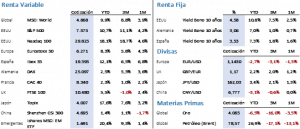
The week ended with mixed performance between Europe and the United States. The rise in Brent crude prices and the increase in interest rates took their toll on European stock markets, which registered significant declines. The Euro Stoxx 50 fell 2.22% to 6,296.97 points, although earlier in the week it reached a new all-time high of 6,431.42 points. Meanwhile, the Ibex 35 declined 2.53%, closing at 19,348.70 points. In the United States, however, the S&P 500 rose 1.23% and the Nasdaq 100 gained 1.69%, closing at 7,575.39 and 29,825.11 points, respectively. The MSCI World index added 0.52%, ending the week at 4,867.82 points.
The bond market reflected the rise in oil prices and the resulting fears of further inflation through a surge in yields. The US 10-year Treasury yield increased by 7 basis points to 4.56%; the German Bund yield rose by 10 basis points to 3.03%; and the Spanish bond yield increased by 9 basis points to 3.51%. The recovery accumulated by fixed income in previous weeks had been remarkable, which explains the intensity of this corrective movement.
The commodities market also registered significant movements. Crude oil was the main protagonist: in just 48 hours it rose by as much as 12%, although by the end of the week the gain was reduced to 5.39%, settling at $76 per barrel. Gold fluctuated between gains of nearly 2% and declines of a similar magnitude, ultimately falling 0.29% to $4,113.70 per ounce. The euro/dollar exchange rate showed a similar behavior to the precious metal; the close at 1.1414 represented a weekly appreciation of the dollar of 0.20%.
The quote:
And we conclude with the following quote from Nelson Rolihlahla Mandela, South African lawyer, anti-apartheid activist, politician, and philanthropist who served as Prime Minister of South Africa from 1994 to 1999: “We must use time wisely and realize that the time is always right to do things right.”
Summary of the performance of major financial assets (July 13, 2026)
This report does not provide personalized financial advice. It has been prepared independently of the specific financial circumstances and objectives of the individuals who receive it.
This document has been prepared by Portocolom Agencia de Valores S.A. for the purpose of providing general information as of the date of issuance of the report and is subject to change without prior notice. Portocolom Agencia de Valores S.A. assumes no obligation to communicate such changes or to update the content of this document. Neither this document nor its content constitutes an offer, invitation, or solicitation to purchase or subscribe to securities or other instruments, or to make or cancel investments, nor may it serve as the basis for any contract, commitment, or decision of any kind.
The information included in this report has been obtained from public sources considered reliable, and although reasonable care has been taken to ensure that the information included in this document is neither uncertain nor ambiguous at the time of publication, we do not represent that it is accurate or complete and it should not be relied upon as such. Portocolom Agencia de Valores S.A. assumes no responsibility for any direct or indirect loss that may result from the use of the information provided in this report. Past performance of variables may not be a good indicator of their future outcomes.