


Financial Markets 08/09/2026
Volatility has been the prevailing theme
in the financial markets throughout the summer months, and it does not seem that
under the current circumstances we are going to see a change in the scenario in the
coming weeks. What is noteworthy, however, is the divergent performance
among the three main types of financial assets: equities,
fixed income and commodities.
Over the past few weeks we have
witnessed a series of upward and downward movements in the
major stock markets, the final result of which has been a slight appreciation
of the main indices. The downward pressure exerted by geopolitics, which
is expected to continue doing so at least in the short term, has been
offset by an excellent earnings season in the United States and a
very positive one in Europe. In addition, corporate outlooks for the remainder
of the year continue to improve across the private corporate sector.
The largest correction has occurred in the
bond markets. Yields have moved higher across all segments of the
interest rate curve, with the rise in longer maturities being particularly
striking. In recent days we have seen levels
not reached for several years. For example, the 10-year German Bund
recorded yields not seen since 2011. The market
is pricing in a scenario of higher interest rates due to
uncertainty in the Persian Gulf and Ukraine, but although this situation
may have an inflationary effect in the short term, over the medium and long term
the implied inflation reflected in fixed-income financial products
remains around 2.4%, that is, unchanged from the situation prior
to the conflict with Iran. What is really concerning fixed-income investors
is the growing volume of public debt in countries such as the United States,
Germany, France or Japan, for which there are no forecasts of improvement in
the short term. In addition, AI is entering the debt markets with
considerable force and appears set to continue doing so during the initial
phase of infrastructure development. A new competitor with enormous financing
needs that could be altering the market situation.
As for commodities, two movements in particular
are worth highlighting. On the one hand, the strong rebound in
crude oil prices. Brent is once again trading close to the $100
per barrel mark, despite the fact that, according to several studies, the flow
of crude oil from the Persian Gulf is estimated to have recovered by at least
70%. Current price levels are putting upward pressure on inflation, although
we may have reached a temporary peak, but the proximity of winter
could put further strain on the markets. The second notable aspect is
the performance of gold. The recovery from the annual lows has been
spectacular, but the latest rise in interest rates triggered a
sizeable correction in prices. Even so, prices remain well
away from both the annual highs and lows.
The beginning of the month brought us updates
on highly relevant data such as PMIs and employment figures in the United States.
Economic activity continues to demonstrate significant strength,
particularly on the other side of the Atlantic. In Europe we have observed some
rotation in growth; Germany and France are performing better than
the peripheral countries, which could ultimately benefit the euro area as a whole.
In the United States, the dynamic remains very solid, a circumstance that
has been reflected in the strong employment data for the month of
August. In any case, we will continue to depend to a great extent on what
happens in Ukraine and Iran, so volatility will remain present in
the markets until definitive peace agreements are reached.
Last week ended with minimal
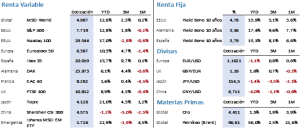
gains in the S&P 500, the Nasdaq 100 and the Ibex 35. All of them are
close to their all-time highs. In addition, they have accumulated gains ranging
from 1.35% for the Ibex to 4.50% for the Nasdaq since the end of July. The
discordant note of the week was the Euro Stoxx 50, which closed with a decline of
1.43%, although it has gained half a percentage point since July.
Government bonds saw their respective
yields rebound, closing at multi-year highs. The
10-year U.S. Treasury ended the week with a yield of
4.78%, that is, 6 basis points above the previous week. In Europe,
the Bund ended at 3.34% and the Spanish bond at 3.77%, representing
weekly increases of 7 and 4 basis points, respectively. During the
current week, the ECB meeting will take place, for which the market
is pricing in a 25-basis-point hike, although there are numerous dissenting views
anticipating several cuts during 2027 if the hike is ultimately
approved on Thursday, September 10. As for the Federal Reserve,
the market changes its bias practically every day and today assigns a
significant probability to a 25-basis-point hike on the 16th, although this does not appear
to be the most likely scenario. The inflation figure to be released next
Friday could become the determining factor for the final decision.
Gold and oil performed in a
similar manner over the past month, with gains of more than 9% in both cases. However,
last week the strong rebound in crude oil and interest rates
triggered a correction in commodities, leaving gold at $4,476.60
per ounce, a decline of 1.17%, while Brent closed at
$96.28 per barrel, appreciating by 8.98% over the week. The U.S.
dollar has not had a significant impact in recent days,
but it came close to trading at its 2025 year-end closing level (1.1750) after rebounding
from the annual lows of 1.1315. Forecasts suggest that we could see
further depreciation of the dollar, although not as intense as that
expected a few months ago. The 1.20 level is now the
market consensus target.
The quote:
And we will say goodbye with the following quote from Thomas
Jefferson, third President of the United States, who is considered one of the
Founding Fathers of the nation and the principal author of the United
States Declaration of Independence: ”If you want something you have never
had, you will have to do something you have never done.”
Summary of the performance of major financial assets (9/7/2026)