


Financial Markets 15/09/2026
The fixed-income markets experienced
sharp increases in yields. Although the U.S. CPI was
published in line with expectations, the events of the week led
investors to anticipate that interest rates will remain elevated for
longer than previously expected. It is worth noting that the U.S.
inflation data showed that current inflation levels are due exclusively
to developments in oil prices and their derivatives; the rest of the
components showed very normal behavior and were consistent with the
FED’s inflation targets.
Why, then, did the market react by
sending global interest rates to levels not seen for years? Once
again, the answer lies with President Trump and his “cheerful
comments.” First, he allowed himself to anticipate an end to the war
that will not occur before the midterm elections, something we could
already foresee, but which, once confirmed, generates greater
uncertainty, especially after seeing how the oil market reacted.
Second, Trump himself had the brilliant idea of granting USD 5,000 to
every American if he won the November elections. According to initial
estimates, this would imply an additional deficit of USD 1.3 Trn,
equivalent to 2.5% of the current U.S. public debt. Let us remember
that the Federal Administration of the United States has just reached
USD 40 Trn in debt and is very close to its spending ceiling, which, if
reached, could once again bring government activity to a standstill.
But we cannot forget, thirdly, that Iran maintains its belligerent
stance and is managing to shift military action to the Red Sea, where
Yemeni Houthi forces are attacking key sites in Saudi Arabia, an area
through which part of the oil traffic was being diverted to avoid
transiting the Strait of Hormuz.
In Europe, the ECB did not alter the script
that had been expected for some time. Despite the fact that Q2 2026
GDP once again came in well below expectations, with annualized growth
of 0.5%, the highest monetary policy authority once again raised the
benchmark interest rate for the eurozone by 25 bps, bringing it to
2.5%. Furthermore, given the upward spiral and concerns about the
impact of interest rates in the United States, the market is pricing
in up to three additional rate hikes in the coming months, precisely
at a time when Europe’s peripheral countries are seeing their economic
activity begin to show signs of weakness. This situation contrasts with
the improvement observed in Germany and France, although this has been
confined exclusively to their manufacturing sectors. Christine Lagarde
hinted that they would raise the benchmark interest rate again in
December if current dynamics did not change over the coming weeks.
During the week we will learn about new
macroeconomic indicators, although investors’ focus will remain
centered on the decision taken by the FED next Wednesday. The market
is currently pricing in a 25 bps hike, more as a consequence of global
events than of the inflation data themselves, since the sharp rise in
oil prices could eventually affect the economy as a whole. Nevertheless,
to date, the feared second-round inflation effects are not occurring.
In China, the unemployment rate and industrial production index will
be published. In Europe, we will learn about the investor confidence
indicator compiled by the ZEW Institute and the industrial production
data. In the United States, in addition to the FED decision, it will be
important to monitor the evolution of retail sales and industrial
production.
Against this particularly complex backdrop,
the main global stock markets barely reflected any significant
corrections, although the close was well above the weekly lows. The
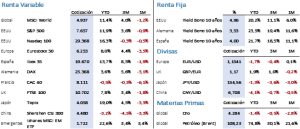
S&P 500 fell 0.80% to finish at 7,657 points, while the technology-heavy
Nasdaq 100 declined 0.60%, closing at 29,368.44 points. In Europe, as
usually happens when energy commodities become more expensive, the
declines were slightly larger, with both the Euro Stoxx 50 and the Ibex
35 falling 1.06%, closing at 6,325.13 and 19,838.50 points,
respectively. Once again, it appears that investors continue to place
more confidence in the economic strength of companies than in the
governments’ ability to act and their economic policies.
The fixed-income market was an entirely
different story. Trump’s proposals and the tension in Iran and its
surrounding areas painted a very negative picture for bonds, which
reached yields not seen for a very long time, to the point that 5% on
the ten-year Treasury is practically a reality. The bonds of the main
economies saw their financing costs increase by close to 20 bps, closing
at 4.975% in the United States, 3.50% in Germany and 3.96% in Spain.
These are levels close to 1% above those prevailing at the market close
on February 27, the date on which the attacks on Iran began.
The most striking movements were
recorded in commodities, especially oil. Brent appreciated by 8.65%
during the week and closed at USD 104.61 per barrel; that said, it
came close to USD 110. The proximity of winter in the Northern
Hemisphere, Trump’s statements and the attacks in Saudi Arabia
provided the perfect breeding ground for the sharp rise in crude oil
prices. In addition, there are indications that China is once again
participating in the market, as the price of oil in Shanghai has risen
very rapidly in recent sessions and has once again surpassed the London
Brent market. If this trend is confirmed, it would represent an
additional factor pointing to elevated oil prices in the short term.
The quote:
And we bid farewell with the following quote from
Francisco Gómez de Quevedo Villegas y Santibáñez Cevallos, a Spanish
nobleman, politician and writer of the Spanish Golden Age: «No one
offers as much as the one who does not intend to fulfill their
promise«.
Summary of the performance
of major financial assets (9/14/2026)