


Financial Markets 29/09/2026
The beginning of autumn has been marked by a sharp contrast between equity and fixed-income markets. The latter have been affected by an accumulation of factors that has pushed long-term debt yields to levels not seen for more than two decades.
First, during the United Nations General Assembly, Donald Trump once again threatened to destroy Iran if it did not agree to negotiate a peace deal under the conditions proposed by the United States. For its part, Iran announced a proposal to reopen the Strait of Hormuz within seven days following a simple and clear roadmap, while at the same time renewing its verbal threats against the United States. Second, following a promising start to the week that pushed Brent below USD 100 per barrel, the escalation of geopolitical tensions once again drove its price above USD 105 per barrel. Third, and as an additional factor supporting the economic outlook, PMI indices surprised positively in both Europe and the United States. The U.S. figures stood out particularly, reinforcing the optimistic view that a significant part of the financial community holds regarding the world’s largest economy.
Another of the week’s most eagerly awaited events was the meeting between Donald Trump and Xi Jinping. However, the meeting was somewhat disappointing, as the main issues on which progress had been expected apparently remained postponed for future negotiations. These included agreements concerning rare earths, reciprocal technology restrictions, and agricultural product purchases. The positive note was the agreement to extend until January 2027 the tariff framework that has been in place for almost a year and was due to expire in October.
On the geopolitical front, there continues to be no significant progress either in the Middle East or in Ukraine. In the Middle East, the most significant clashes are taking place in Yemen, where the Houthis have taken control of certain strategic cities, making it more difficult for oil tankers to transit through the Red Sea. Saudi Arabia and its allies continue to support the Yemeni army in its fight against the Iranian-backed Houthi militias. In addition, there are indications that China may be exerting diplomatic pressure on Iran to prevent the conflict from spreading to other countries in the region, which would further aggravate global oil and gas supply problems.
Precisely, the flow of hydrocarbons from the oil-producing countries of the Persian Gulf represents one of the few relatively positive developments. According to various media outlets, around 16 million barrels of oil equivalent per day are currently being exported (other sources put the figure at 13 million barrels). Although this figure remains considerably below the 23.2 million barrels per day recorded a year ago, it implies that approximately 75% of the volume that transited through the Strait of Hormuz in 2025 continues to flow.
Against this international backdrop, a broad correction across financial markets might have been expected. However, that was not what happened. While bond valuations declined steadily throughout the week and yields reached levels not seen even before the global financial crisis, precious metals experienced relatively significant corrections, although far from alarming. In other words, the performance was consistent with an environment characterized by rising interest rates.
These rate increases could continue over the coming year. In the United States, markets are pricing in as many as four additional hikes, while the Federal Reserve maintains a much more moderate forecast and anticipates only one increase. In Europe, the yield curve is pricing in one additional hike in 2026 and two more in 2027, despite the OECD maintaining certain reservations about the growth capacity of European economies.
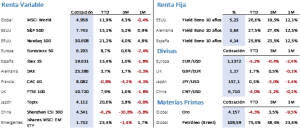
Nevertheless, not everything was negative. Equity markets posted broad-based gains of more than 1%. If there is one asset capable of preserving purchasing power against inflation over the long term, it remains equities. During the past week, the S&P 500 gained 1.21% to close at 7,743.41 points, very close to its all-time highs. The Nasdaq 100 was one of the best-performing indices, gaining 3.25% and reaching a new all-time high of 30,770.63 points, a level very close to Friday’s close. In Europe, the dynamics were similar. The Euro Stoxx 50 gained 1.07% and the Ibex 35 0.95%, ending the week at 6,302.82 and 19,700.10 points, respectively, although still some distance from their annual highs.
Government bonds recorded significant increases in yields. Specifically, the U.S. ten-year Treasury yield moved well above the 5% threshold, reaching 5.17%, an increase of 17 basis points from the previous weekly close. Meanwhile, the German Bund rose 10 basis points to 3.62%, while the Spanish ten-year bond increased 11 basis points to 4.11%. Everything points to fixed income remaining the main source of financial instability in the short term.
Among alternative assets, the U.S. dollar was one of the week’s major beneficiaries. The currency approached its annual highs against most international currencies, supported both by relatively high interest rates and by its status as a safe-haven asset during periods of uncertainty. Gold corrected 2.43% as a result of higher bond yields and closed at USD 4,321.20 per ounce, although it ended clearly above the lows reached during the week. Finally, it is worth noting that Brent barely advanced 0.43%, to USD 104.32 per barrel at the close. However, volatility remained very high, with a weekly range of more than USD 10 between the low of USD 97.51 and highs above USD 108.
The current week will once again be marked by highly relevant macroeconomic indicators for the markets and, therefore, significant market movements cannot be ruled out. In Europe, attention will focus on the release of the final September PMI figures, the unemployment rate, and the preliminary CPI for the same month. In the United States, attention will center on the traditional set of labor-market indicators released at the beginning of the month, including JOLTS job openings, the ADP report, nonfarm payrolls, and the unemployment rate. In addition, the final reading of second-quarter 2026 GDP and the August PCE figure will be released.
The quote:
And we leave you with the following quote from Ingmar Bergman, Swedish film director, screenwriter, and playwright, considered one of the key figures of the second half of the 20th century and in the history of world cinema: «Growing old is like climbing a great mountain: as you climb, your strength diminishes, but your gaze is freer, your view broader and more serene«.
Summary of the performance of major financial assets (28/9/2026)