



Financial Markets 06/10/2026
We have entered the last quarter of the year with high levels of volatility in assets as diverse as precious metals, oil, and fixed income. Among these, the movements occurring in the debt market stand out, where the wide daily or weekly price ranges in which bonds trade are generating additional tension for investors. The evolution of this market remains particularly relevant, as it continues to act as a benchmark for the valuation of other financial assets.
Geopolitics maintains pressure on oil.
Geopolitical uncertainty has not improved at all. The war continues in Ukraine and the Middle East, not to mention the ongoing armed clashes in the Near East. Proposals to try to end the war in Iran have been systematically rejected, and it seems increasingly clear that a definitive agreement will not be reached until after the midterm elections in the United States.
Meanwhile, the price of Brent crude remains anchored above $100 per barrel at a time when the US dollar has appreciated by nearly 5% in recent weeks. This combination of a strong dollar and high energy prices continues to be a major concern for businesses, consumers, and central banks.
One of the few positive developments of the week, albeit a short-term solution, was the agreement reached between the United States and China. The two powers agreed to extend their tariff agreement until January 10th and also approved a reduction or partial exemption on $30 billion worth of goods within the trade flows between the world’s two largest economies. This is a measure of limited scope, but it contributes to partially reducing existing tensions in international trade.
The US labor market continues to show strength.
At the macroeconomic level, US employment data again reflected the volatility observed over the past year. Particularly positive data is not usually corroborated by the following release; quite the contrary, as happened with the figures for September. In September, 29,000 jobs were created compared to the 89,000 projected for the non-farm payrolls report, while the August figure was revised downward by 30,000 jobs. The initial interpretation of these data is that the health of the labor market remains positive, although without showing the signs of overheating suggested by the August data, which would have prompted further tightening of monetary policy.
Furthermore, the September PMI readings were significantly revised downward compared to the preliminary figures. Overall, the US economy maintains a reasonably solid growth trajectory, but without reaching levels that could be considered exuberant. This balance continues to be one of the aspects most closely watched by financial markets.
Fixed income remains the main focus of attention.
However, the market’s reaction to the employment and economic activity data was mixed. Logically, one would have expected a significant correction in bond yields. If the August data triggered an upward movement in yields unseen for many years, the September data should have provoked a reaction in the opposite direction. The reality was different. Only the German Bund corrected, while the Spanish Bond remained largely unchanged, and the US Treasury once again closed the week with sharp increases in its yield. Doubts about the high public deficit and the debt accumulated in recent years continue to put pressure on financing costs in the United States.
Nevertheless, one of the most relevant aspects of the week was that the market has stopped pricing in four additional increases in the benchmark interest rate by the Fed over the next twelve months. Although this change could be temporary, it represents a moderation of the expectations that had dominated the market in recent weeks. Attention in the coming days will remain focused on negotiations to end armed conflicts, as there will be no particularly relevant macroeconomic data. China will remain closed until October 7th as they celebrate the National Day of the People’s Republic of China. Retail sales data will be released in Europe, and in the United States, the University of Michigan’s consumer confidence and inflation expectations indicators will be published. In addition, both the Fed and the ECB will release the minutes of their latest monetary policy committee meetings, documents that could provide new clues about the future evolution of interest rates.
Energy once again becomes a key factor.
Another of the most relevant elements at the moment is the pressure that high energy prices continue to exert on inflation and policymakers. The G7 has reached an agreement to release 100 million barrels of crude oil and diesel from its strategic reserves with the aim of easing pressure on citizens’ spending power and partially reducing tensions in energy markets. It remains to be seen in the coming weeks whether this measure will be sufficient to bring about a correction in oil prices. All of this is happening in an environment where, according to the source used, crude oil and gas exports from the Persian Gulf countries have recovered between 50% and 90% of the volumes that existed before the start of the war, a circumstance that adds uncertainty to global supply and demand forecasts.
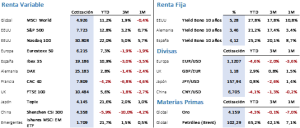
Europe and the United States show different behaviors. Given this scenario, the behavior of stock markets was once again clearly different on either side of the Atlantic. Uncertainty continues to weigh on European stock exchanges, even though macroeconomic data continues to show a relatively favorable trend. Added to this is the political situation in countries like France and Spain (where early elections have just been announced for next November), which continues to influence market valuations. The Euro Stoxx 50 fell 2% during the week, closing at 6,175.45 points, while the Ibex 35 performed even worse, losing 3.12% to finish at 19,085.30 points. In contrast, US equities remained remarkably more resilient. The S&P 500 declined by just 0.27%, while the Nasdaq 100 rose 0.65%, closing at 7,722.72 and 30,807.93 points, respectively. Notably, on Friday, the Nasdaq 100 surpassed 31,000 points for the first time, setting a new all-time high of 31,017.53 points.
A particularly volatile week for debt and commodities The debt market experienced another particularly complex week, characterized by wide price movements and very different performances among the major developed economies. Expectations regarding inflation, interest rates, the labor market, and public debt continue to shift rapidly as new economic and geopolitical factors emerge. The week ended with the US Treasury yield rising 10 basis points to 5.28%. However, it had fallen as low as 5.16% during the week following the release of employment data, after reaching its yearly high of 5.35% on Thursday. The German Bund improved significantly, reducing its yield by 17 basis points to 3.45%, while the Spanish Bond remained stable at 4.11%. The rise in Treasury yields had a direct impact on precious metals, especially gold, which fell 3.67% to close at $4,162.30 per ounce. At the same time, the oil market continued to exhibit high volatility. Brent crude twice attempted to fall below $100 per barrel, but ultimately finished the week up 3.47%, closing at $102.25. Meanwhile, the dollar strengthened again, reaching new yearly highs against the euro. The US currency closed at 1.1254 against the European currency, representing a weekly appreciation of 1.20%.
Outlook for the last quarter
Markets are facing the final stretch of the year with an unusual combination of geopolitical uncertainty, high energy prices, and strong volatility in fixed income. Although economic activity continues to show remarkable resilience, doubts about the future trajectory of inflation, interest rates, and public debt continue to influence investor expectations. In this context, oil price developments, central bank decisions, and the ability of economies to maintain growth without generating new inflationary pressures will likely remain the factors shaping market direction in the coming weeks.
The quote:
And we conclude with the following quote from John XXIII, Pope of the Catholic Church and the third sovereign of Vatican City: «Justice is defended with reason, not with weapons. Nothing is lost with peace, and everything can be lost with war.»
Summary of the performance of major financial assets (05/10/2026)
This report does not provide personalized financial advice. It has been prepared independently of the specific financial circumstances and objectives of the individuals who receive it.
This document has been prepared by Portocolom Agencia de Valores S.A. for the purpose of providing general information as of the date of issuance of the report and is subject to change without prior notice. Portocolom Agencia de Valores S.A. assumes no obligation to communicate such changes or to update the content of this document. Neither this document nor its content constitutes an offer, invitation, or solicitation to purchase or subscribe to securities or other instruments, or to make or cancel investments, nor may it serve as the basis for any contract, commitment, or decision of any kind.
The information included in this report has been obtained from public sources considered reliable, and although reasonable care has been taken to ensure that the information included in this document is neither uncertain nor ambiguous at the time of publication, we do not represent that it is accurate or complete and it should not be relied upon as such. Portocolom Agencia de Valores S.A. assumes no responsibility for any direct or indirect loss that may result from the use of the information provided in this report. Past performance of variables may not be a good indicator of their future outcomes.