


Financial Markets 10/11/2026
The US elections and the collapse in oil prices restore optimism to markets, which are regaining their appetite for risk
The past week marked a significant shift in tone across financial markets. After several weeks dominated by energy concerns, geopolitical uncertainty and fears of a fresh surge in inflation, investors found reasons to recover some of their lost optimism. The combination of US election results, interpreted as moderating political risk, a sharp decline in oil prices and falling sovereign bond yields helped drive a broad-based improvement in market sentiment.
The most significant development was undoubtedly the correction in oil prices. After reaching their highest levels in more than a decade at the end of October, Brent crude recorded a weekly decline of more than 13%, making it one of the most significant moves of the year. This adjustment eased some inflationary concerns and allowed investors to refocus their attention on the fundamentals of the global economy, which continue to demonstrate greater resilience than anticipated just a few months ago.
US midterm elections reduce some of the political uncertainty
The main political event of the week was the midterm elections in the United States. The Democratic Party’s regaining of control of Congress was interpreted favourably by a significant part of the market, as it was seen as a factor capable of introducing greater institutional checks and balances and reducing the risk of particularly aggressive decisions on trade, fiscal or regulatory policy.
Investors believe that a greater balance of power reduces the likelihood of abrupt changes in the economic direction of the world’s largest economy. In an environment where politics increasingly influences the performance of financial markets, any factor that helps improve predictability is generally welcomed. Nevertheless, considerable uncertainty remains under the Trump administration.
The Middle East ceases to be the main source of concern for energy markets
For much of October, developments in tensions between the United States and Iran captured the markets’ attention. Fears of potential disruptions to international energy supplies pushed oil prices to levels not seen for more than a decade. However, a more favourable perception prevailed over the past week. Investors began pricing in a lower probability of significant disruptions to international crude transportation and a possible easing of diplomatic tensions. As a result, Brent crude fell by 13.3%, reversing a substantial part of its previous sharp gains.
Europe maintains growth, although it continues to show greater fragility than the United States
European data released during the week provided mixed signals. Preliminary inflation for October stood at 4%, while core inflation remained unchanged at 2.5%. Meanwhile, leading indicators continue to point to moderate economic expansion. However, retail sales fell by 0.7%, reflecting weaker private consumption. This trend remains one of the main sources of vulnerability for the European economy.
Added to this are various political and fiscal uncertainties across several countries in the region, particularly France and Spain. These circumstances explain why Europe continues to be perceived by many investors as an economy that is relatively more sensitive to changes in the international environment.
The United States remains the strongest economy among the major developed regions
The US economy once again showed signs of strength. Activity indicators (PMIs) performed positively in both manufacturing and services, while factory orders continued to grow at a reasonable pace.
Of particular significance was the official employment report. Non-farm payrolls increased by 165,000 jobs, compared with the 65,000 expected by market consensus, while the unemployment rate fell to 4.1%. These figures show that the labour market remains considerably strong and continues to act as one of the main pillars supporting the US economy.
Mixed performance across international equity markets
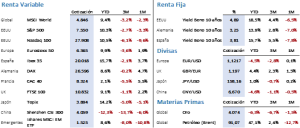
Equity markets recorded uneven performances across regions. The United States experienced a week of consolidation following the strong gains accumulated over recent months. The S&P 500 fell by 2.61%, while the Nasdaq 100 declined by 4.91%, reflecting greater pressure on large-cap technology companies. Elevated valuations across parts of the technology sector, together with doubts about the pace of AI development following the US election upset, triggered a sharp sell-off on Thursday, partially reversed on Friday.
In Europe, by contrast, performance was considerably more positive. The Euro Stoxx 50 gained 0.64%, while the Ibex 35 led gains among the major developed markets, rising by 3.84%. The sharp correction in oil prices and the decline in bond yields particularly benefited the financial and industrial sectors, allowing European stock markets to recover some of the ground lost during October.
Fixed income regains its appeal following the decline in yields
Government bond markets performed favourably throughout the week. The fall in oil prices helped ease inflationary concerns and contributed to a decline in yields across major sovereign bonds.
In the United States, the yield on the 10-year Treasury bond fell from 4.93% to 4.86%, while the German Bund yield declined from 3.32% to 3.25%. Spanish government bonds also performed positively, with yields falling from 3.95% to 3.84%.
Oil prices correct sharply as precious metals regain the spotlight
Commodity markets accounted for some of the week’s most significant movements. Brent crude fell by 13.3%, shifting from being one of investors’ main sources of concern to becoming one of the factors that contributed most to improving market sentiment.
At the same time, precious metals regained prominence. Gold rose by 4.51% and silver by 5.40%, benefiting from lower real yields and the persistence of certain geopolitical risks that remain part of the international landscape.
There were hardly any significant movements in the foreign exchange market.
Key factors for the week ahead
Market attention will focus on four main factors: the release of US October CPI data, with particular attention to core inflation, and the preliminary estimate of European GDP.
If inflation figures continue to show a moderating trend and economic activity maintains the strength observed over recent weeks, markets could consolidate the recovery that has recently begun. However, the persistence of geopolitical risks and the elevated valuations of certain assets warrant a cautious and selective approach.
The quote:
We would like to leave you with a quote from a well-known African proverb, immortalised on the Berlin Wall by artists Kani Alavi and Muriel Raoux: “Many small people, in many small places, doing small things, can change the face of the world.”
Summary of the performance of major financial assets (10/11/2026)