


Financial Markets 23/11/2026
Last week was marked by a widespread correction across major risk assets following the highs reached in early October. Investors have shifted their focus from inflation trends and interest rates to once again questioning the valuations reached by certain companies linked to artificial intelligence. The trigger was Anthropic’s stock market debut, which attracted considerable anticipation but failed to dispel doubts about the future profitability of the enormous investments made in the sector. As a result, international equities recorded significant declines, particularly in the United States, while safe-haven assets maintained a defensive performance.
Equities: Artificial intelligence puts markets to the test once again
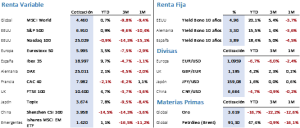
Stock markets ended the week with widespread losses. The S&P 500 fell by approximately 7%, the Nasdaq 100 by more than 10%, the Euro Stoxx 50 by around 4% and the Ibex 35 by close to 6%. The adjustment was particularly sharp in the US technology sector, where investors reassessed expectations following several months of strong gains. Anthropic’s stock market debut was the main corporate event of the week, but its performance failed to dispel doubts about the ability to monetise investments in artificial intelligence.
The underlying reason for this correction does not appear to be a deterioration in the global economy but rather a reassessment of expectations. Corporate earnings remain solid and economic activity continues to grow at a moderate pace. However, after a prolonged period of strong stock market gains, any factor encouraging caution tends to trigger profit-taking of a certain magnitude.
Fixed income: bonds regain prominence
While equities were correcting, debt markets once again acted as a safe haven. The yield on the US 10-year Treasury fell from 5.15% to 4.91%, while the German Bund declined from 3.38% to 3.30% and the Spanish 10-year bond from 3.94% to 3.91%.
This trend reflects the view held by part of the market that recent inflationary pressures could ease over the coming months. Furthermore, some economic activity data recently published in the United States and Europe showed a degree of slowdown compared with previous readings. Consequently, the possibility that central banks have room to maintain a cautious approach before introducing further measures is once again gaining traction.
Commodities and currencies: precious metals decline while energy markets remain stable
Commodities showed a mixed performance. Gold and silver recorded significant declines, extending the correction that began the previous week. The falls were driven by profit-taking, while the substantial gains accumulated in 2025 still leave room for further profit-taking in an environment of elevated volatility.
By contrast, Brent crude experienced only a limited correction and continues to trade at elevated levels, close to $93 per barrel. Tensions in the Middle East continue to support energy prices and sustain concerns about the future trajectory of global inflation.
There were hardly any significant movements in the foreign exchange market. The euro closed slightly below the previous week’s levels against the US dollar, reflecting the relative strength that the US economy continues to display.
Macroeconomics: moderate growth and mixed signals
The data released throughout the week reflected a global economy that continues to expand, albeit at an uneven pace. In China, industrial production came in slightly below market expectations, while the unemployment rate showed a modest improvement. Weak domestic demand remains the main challenge facing the Chinese authorities.
In Europe, the ZEW Economic Sentiment Index improved by more than expected, providing a positive signal for the coming months. However, industrial production continues to struggle to regain momentum. Inflation remains elevated, although it is still following a trajectory consistent with gradual stabilisation.
The United States continues to present the strongest outlook among the major developed economies. Retail sales increased slightly and the labour market remains at historically favourable levels. Nevertheless, some manufacturing indicators are beginning to point to a moderation in growth, which the market will continue to monitor closely.
Geopolitics: a week packed with international developments
On the geopolitical front, the first trilateral summit between Donald Trump, Xi Jinping and Vladimir Putin, held on the sidelines of the APEC meeting in Shenzhen, was a key event. Although the meeting concluded without any concrete agreements, it demonstrated the three powers’ willingness to maintain open channels of dialogue on international security, trade and strategic stability.
The situation in Ukraine deteriorated once again following a new wave of Russian attacks on critical infrastructure, while Poland reported incidents near its airspace. These developments reignited the debate over strengthening Europe’s defensive capabilities and the future role of NATO.
In the Middle East, tensions persist following Houthi attacks against Saudi targets and negotiations concerning nuclear cooperation between the United States and Saudi Arabia. Although the energy market did not react with sharp price movements, these developments continue to represent one of the main risks to oil price stability.
What to watch this week
Investors’ attention will focus on three main areas. In the United States, key releases will include The Conference Board’s Consumer Confidence Index, October’s PCE index and the Federal Reserve’s Beige Book. In Europe, the focus will be on the preliminary November PMIs and the minutes of the European Central Bank. In China, investors will continue to monitor any measures aimed at boosting economic activity and domestic consumption.
On the political and geopolitical front, developments surrounding the conclusions of the Shenzhen summit, the evolution of the war in Ukraine and any news related to the Middle East will remain relevant. Following the recent market correction, these developments will help determine whether the move was a temporary valuation adjustment or the beginning of a more prolonged period of volatility.
The quote:
We conclude with the following words from Francis of Assisi, founder of the Franciscan Order: «Start by doing what is necessary, then what is possible, and suddenly you are doing the impossible«.
Summary of the performance of major financial assets (23/11/2026)